





















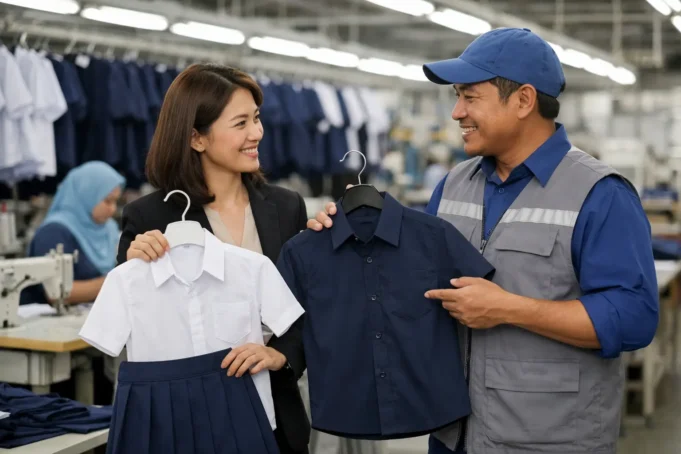
A school uniform is tested far beyond the fitting room. It faces humid mornings, packed buses, assembly lines, sports periods, repeated washing, and the daily wear of active students. That is why selecting a school uniform manufacturer Malaysia schools can depend on is a procurement decision, not simply an apparel order. The right production partner protects consistency across grades, manages sizing at scale, and delivers garments that represent the school well through an entire academic year.
For school operators, boards, parent associations, and appointed uniform retailers, the goal is to balance durability, comfort, visual standards, and accessible pricing. The best manufacturer is not necessarily the one quoting the lowest unit price. It is the one that can repeatedly make the approved garment to specification, communicate clearly when demand changes, and support the school’s long-term uniform program.
What Schools Should Expect From a Malaysian Uniform Manufacturer
A capable school uniform manufacturer should understand that a school program has more moving parts than a basic corporate polo order. Schools may require formal uniforms, physical education kits, outerwear, prefect garments, headwear, socks, house-color shirts, and special items for clubs or graduating cohorts. Each item needs approved materials, clear measurements, stable colors, and a production plan that accounts for enrollment cycles.
The manufacturer should be able to translate a school’s design into workable production specifications. This includes fabric composition and weight, color references, stitching details, collar and cuff construction, button type, pocket placement, logo position, labeling, packing method, and size grading. A clear specification sheet reduces arguments later, especially when orders are handled by a school-appointed retailer or placed in multiple batches.
Local manufacturing can offer practical advantages for Malaysian schools. Communication is easier, sample approvals can be handled faster, and buyers may have more visibility over quality checks and production timing. However, local production does not automatically mean better value. A manufacturer’s machinery, sourcing network, minimum order quantities, and order-book capacity all affect the final result.
Start With Wear Conditions, Not Fabric Names
Many uniform discussions begin with cotton versus polyester. That is too narrow. Fabric selection should start with where, how, and how often students will wear the garment.
For daily shirts and blouses, buyers often look for a fabric that feels comfortable in warm conditions while standing up to frequent laundering. Cotton-rich materials can offer a softer hand feel and breathability, but they may wrinkle more, shrink if not properly controlled, and take longer to dry. Polyester-cotton blends are widely used because they are easier to care for, hold their shape, and can provide better color retention. The appropriate blend depends on the garment category and the school’s priorities.
Physical education apparel has different demands. Knitted performance fabrics may improve moisture management and mobility, while mesh panels can support ventilation. Yet a lightweight fabric that performs well on the field may be too sheer or less resistant to abrasion for everyday use. Ask manufacturers to recommend fabric by application rather than applying one material across every product.
Fabric performance should be verified through samples and, where appropriate, documented testing. Useful considerations include colorfastness to washing and perspiration, pilling resistance, shrinkage tolerance, tear strength, and dimensional stability. Schools with light-colored uniforms should also assess opacity. A garment can look fine on a hanger and become unsuitable under daylight or after repeated washes.
Color continuity matters across reorder seasons
Navy, maroon, green, and school-specific shades can vary between fabric lots. A small difference becomes obvious when students wear new and older garments together. Establish an approved color standard before bulk production and ask how the manufacturer manages lot consistency. If the program includes multiple suppliers or retailers, this control becomes even more important.
Fit, Size Grading, and Student Comfort
Poor sizing creates avoidable pressure on administrators and parents. It also leads to excess exchanges, unsold inventory, and rushed top-up orders during back-to-school periods. A supplier’s size chart should not be treated as a generic attachment. It should reflect the school’s student population and the intended fit of each garment.
Ask whether the manufacturer can provide a full size set for fitting sessions. This allows staff, parents, or retail partners to assess chest, waist, hip, body length, sleeve length, and ease of movement before production is locked. It is particularly useful for transition years, when students may be between children’s and adult sizes.
Design details can improve comfort without changing a school’s recognizable appearance. Adjustable waistbands, reinforced knee areas, side elastic inserts, longer shirt tails, and well-positioned vents can make garments more practical for active use. These features add cost, so they should be evaluated against the expected life of the garment and the school’s price target.
Branding and Decoration Need Production Discipline
School crests carry more significance than a simple promotional logo. They are a visible marker of identity, and inconsistencies are noticed quickly by staff and families. Embroidery remains a common choice for woven shirts, blazers, caps, and certain outerwear because it has a traditional, durable appearance. For sportswear, heat transfer, screen printing, and digital decoration may better suit lightweight fabrics or detailed house graphics.
Each method has trade-offs. Dense embroidery can stiffen fine fabric and may cause puckering if backing and tension are poorly managed. Screen printing can be economical for larger runs of simple artwork but requires careful color control and curing. Heat transfers offer flexibility for names and small batches, though the material and application process must be selected for wash durability.
Request a pre-production sample with the actual crest, thread colors, or print artwork before approving the full order. The sample should be reviewed for placement, scale, readability, reverse-side finish, and behavior after washing. A manufacturer with in-house decoration may provide tighter control, while a specialist decorator can be the better choice for technically demanding graphics. What matters is that accountability is clear.
How to Compare School Uniform Manufacturer Malaysia Quotes
A quote only becomes useful when every supplier is pricing the same specification. Comparing a basic shirt quote against a reinforced, branded shirt quote can make a stronger supplier appear expensive when the products are not equivalent.
Provide each manufacturer with the same bill of requirements: garment artwork, size breakdown, estimated quantities, fabric standard, branding method, packing requirement, delivery location, target delivery date, and any required samples. Ask suppliers to separate development charges, logo digitizing or screen costs, per-piece pricing, taxes where applicable, delivery, and minimum-order requirements.
Look beyond the first production run. A school may need replenishment for transfers, new admissions, lost garments, or late registrations. Confirm whether the manufacturer can retain fabric, trims, embroidery files, patterns, and approved specifications for future orders. Also ask about the minimum quantity and expected lead time for reorders. A low initial price may lose its appeal if every top-up order requires a large minimum quantity or an extended wait.
Questions worth asking before appointing a supplier
A practical buyer review should establish whether the manufacturer has experience with schoolwear, not only general apparel. Ask who owns pattern development, where cutting and sewing take place, how incoming fabric is checked, and what inspection happens before packing. Clarify the escalation process for defects, missing sizes, incorrect logo placement, or late delivery.
Capacity deserves direct attention. Peak uniform demand often gathers around school opening periods, and a factory that is dependable in a quiet month may be overcommitted during the busiest season. Request a realistic production schedule that includes sample approval, material booking, manufacturing, inspection, packing, and delivery. Build contingency time into the school calendar rather than relying on an optimistic lead time.
Quality Control Should Be Visible, Not Assumed
The most useful quality-control process is one a buyer can understand. Manufacturers should inspect fabric before cutting, verify measurements during production, check stitching and decoration, and conduct a final count by size and item before dispatch. For larger programs, buyers may request an agreed inspection standard or arrange a factory visit before final shipment.
Pay particular attention to high-stress points: collar seams, plackets, pocket corners, trouser inseams, waistband attachments, zippers, and button security. These are the areas most likely to reveal weak construction after a few weeks of student wear. Washing a small sample set before bulk approval is one of the simplest ways to identify shrinkage, twisting, color transfer, print cracking, or discomfort.
Packaging also affects the parent and retailer experience. Clear size stickers, item labels, barcode options, and accurate assortment packing make distribution easier. For schools selling uniforms through an approved outlet, organized packing reduces sorting time and minimizes incorrect handovers during busy registration periods.
Build a Supplier Relationship That Supports the School Calendar
A school uniform program works best when the manufacturer receives forecasts early and receives final purchase information in a structured format. Schools can share projected intake, historical size ratios, enrollment growth, and important event dates. In return, the supplier should provide transparent lead times, material alternatives when supply conditions change, and notice before any component is substituted.
Sustainability can be part of the conversation, but claims should be specific. Some schools may prioritize recycled polyester options, longer-wearing construction, reduced packaging, or local production. These choices can support responsible procurement, but they must still meet comfort, cost, and performance needs. A more durable garment that stays in use longer may offer a more meaningful result than a loosely defined environmental claim.
The most effective school uniform supplier is a production partner that treats the garment as part of the school’s operating system. When fabric, fit, decoration, quality assurance, and reordering are planned together, the uniform becomes easier for families to buy, easier for staff to administer, and more reliable for students to wear with pride.