




















A staff uniform order can look straightforward until the first delivery exposes the gaps: inconsistent sizing, a logo that fades after several washes, fabric that is too warm for field teams, or a supplier that cannot repeat the same color six months later. For buyers comparing uniform suppliers in Malaysia, the real task is not finding a company that can make a shirt. It is finding a production partner that can protect brand presentation while meeting the realities of daily work, replenishment, budget, and lead time.
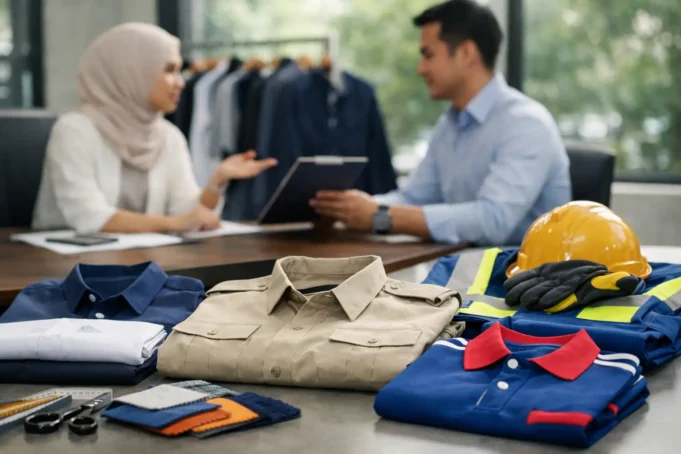
Uniforms operate at the intersection of procurement, operations, HR, and branding. A hotel needs a polished front-of-house look that survives frequent laundering. A construction firm needs garments that support visibility, mobility, and site requirements. A clinic needs practical, hygienic apparel that is comfortable through a long shift. The best sourcing decision begins by defining these operating conditions before requesting quotations.
What Malaysian Uniform Buyers Should Compare First
Price matters, but unit price alone is a weak comparison tool. A lower quote may exclude artwork setup, individual packing, name embroidery, size exchanges, delivery, or a repeat-order color guarantee. It may also be based on a lighter fabric, a simpler construction method, or a minimum quantity that does not suit the organization.
Start with the uniform brief. It should identify who will wear the garments, where they will be worn, how often they will be washed, what branding is required, and when the order must arrive. Include estimated quantities by size, expected reorders, and any department-specific differences. This gives suppliers enough information to recommend an appropriate fabric and decoration method instead of quoting a generic polo shirt or corporate uniform.
For most B2B orders, compare suppliers across these connected areas: garment capability, fabric specification, branding quality, production capacity, commercial terms, and after-sales support. A supplier can be strong in one area and unsuitable in another. For example, an embroidery specialist may produce excellent logo work but outsource garment manufacturing, while a custom made uniform manufacturer may offer greater control over patterns, grading, and repeat production.
Manufacturing capability versus ready-stock supply
Ready-stock uniforms are useful when speed and budget are the priority. Buyers can select existing polo shirts, workwear, scrubs, or safetywear and add embroidery or printing. This route is often practical for smaller teams, event staff, new outlets, and urgent replacement orders. The trade-off is less control over fabric, cut, color, and distinctive brand details.
Custom manufacturing is better suited to organizations that need a specific silhouette, brand color, technical fabric, contrast panels, specialized pockets, modesty features, or consistent supply across multiple locations. It typically requires more development time and may involve higher minimum order quantities. However, it can reduce compromise where uniform appearance and job performance are central to the business.
Ask each supplier whether production is handled in-house, through a regular manufacturing partner, or through a mixed supply chain. There is no single right model, but transparency helps buyers assess lead times, quality responsibility, and the reliability of future repeat orders.
Fabric Is an Operational Decision, Not a Swatch Choice
A fabric sample can feel acceptable in an air-conditioned meeting room and perform poorly on a busy Malaysian worksite. Fabric selection should match climate, movement, exposure, laundering, and the visual standard expected from the role.
Cotton-rich fabrics are often valued for comfort and a natural hand feel, but they may crease more and can need more careful color management. Polyester blends generally offer durability, color retention, and easier care, making them common in corporate polos, hospitality uniforms, and operational workwear. Performance fabrics can improve moisture management, stretch, breathability, or odor control, but their benefits should be relevant to the wearer rather than used as marketing language.
Request fabric weight, fiber composition, weave or knit type, and color reference in writing. If the garment is intended for industrial, healthcare, food-service, or outdoor use, ask about applicable performance requirements rather than assuming a fabric is suitable. Flame-resistant workwear, high-visibility garments, anti-static textiles, and protective apparel require more specific technical verification than standard branded clothing.
Laundering is where many uniform decisions succeed or fail. Ask what shrinkage, colorfastness, pilling, or logo durability can reasonably be expected after repeated washes. A supplier should also be able to advise on care labels that match the garment construction and decoration method. The most attractive uniform is not a strong commercial asset if it looks tired after a few weeks of use.
Evaluate Branding Methods by Use Case
Embroidery, screen printing, heat transfer, direct-to-film printing, sublimation, and woven badges each solve different problems. The best option depends on artwork detail, fabric type, placement, quantity, budget, and how the garment will be used.
Embroidery gives corporate shirts, jackets, caps, and hospitality uniforms a textured, durable finish. It works well for simpler logos but may be less suitable for very small text, fine gradients, or lightweight fabrics where the backing can affect drape. Screen printing can be economical for larger quantities and bold artwork, while heat transfers can support detailed logos and individual names on lower-volume orders. Sublimation is effective for all-over sportswear graphics but requires compatible polyester-based fabric.
Do not assess decoration from a digital mockup alone. Request a physical pre-production sample or strike-off with the actual fabric, thread, ink, transfer, and logo size. Check placement from a normal viewing distance, not only at close range. A logo that is technically accurate can still look undersized, too high on the chest, or poorly balanced against the garment design.
Questions to Ask Uniform Suppliers in Malaysia
The supplier conversation should test how well the company manages the full order cycle, not just how quickly it responds to a quotation request. Useful questions include whether the supplier can provide a size set, how it handles approval changes, who signs off on artwork, and what happens if delivered quantities or specifications differ from the approved sample.
Ask for a clear production timeline that separates sampling, approval, bulk production, finishing, packing, and delivery. This is especially important for seasonal hospitality launches, school intakes, opening events, and multi-location rollouts. A promised lead time means little if it begins only after artwork, deposit, and size confirmation are complete.
For ongoing programs, clarify repeat-order conditions. Can the supplier maintain the same fabric and color? Is the logo file retained? Will the same pattern and grading be used? What is the minimum quantity for top-up orders? These details matter more than a small first-order saving when a business expects to hire new staff throughout the year.
Supplier profiles and manufacturer profiles can speed up the initial shortlist by showing relevant product categories, decoration capabilities, and sector experience. A directory resource such as Uniform Catalogue can help buyers identify companies across garments, textiles, embroidery, printing, and custom production, but the final selection should still be based on documented specifications and samples.
Build a Sampling and Approval Process That Prevents Rework
Approval is the buyer’s strongest quality-control point. Before bulk production, confirm the garment style, fabric, color, measurements, logo artwork, decoration placement, thread or print colors, name personalization, labels, packaging, and carton breakdown. Keep the approved sample and specification sheet as the reference standard for delivery and future orders.
Sizing needs particular care. Generic S to XXL labels do not guarantee consistent measurements between brands or factories. Request a measurement chart with key points such as chest, body length, shoulder, sleeve, waist, hip, and inseam where relevant. For large teams, use fitting sessions or size sets rather than relying solely on staff self-selection. This reduces exchanges and prevents a uniform rollout from becoming an administrative problem for HR.
If garments are being issued across branches, plan the distribution method before production begins. Individual name-and-size packing adds cost, but it can save significant time at the receiving end. The right choice depends on order scale, number of locations, and whether uniforms will be issued centrally or through department managers.
Calculate Total Cost, Not Only the Quoted Price
A useful quote should make cost drivers visible. Compare garment price, customization charges, setup fees, sample costs, packaging, delivery, taxes where applicable, and the cost of replacements or additional sizes. For custom programs, also account for the value of pattern development and approved repeatability.
Lowest cost is not always poor value, and premium pricing is not automatically evidence of better quality. The practical question is whether the garment will meet its intended life cycle without creating rework, dissatisfaction, or inconsistent brand presentation. A restaurant with high staff turnover may prioritize fast replenishment and durable stock polos. A luxury property may justify custom tailoring and higher-grade decoration because the uniform is part of the guest experience.
Responsible sourcing is also becoming a more relevant commercial consideration. If recycled polyester, lower-impact dyes, traceable fabric, local production, or waste reduction matters to your organization, raise it at the briefing stage. Suppliers need a clear requirement to propose realistic options, along with any cost, minimum-order, or lead-time implications.
The strongest uniform program is built around a supplier that can deliver the right garment repeatedly, not simply the first time. Treat the sample, specification sheet, and supplier communication process as operating tools. They turn a uniform order from a one-off apparel purchase into a dependable part of how your people look, work, and represent the business.