





















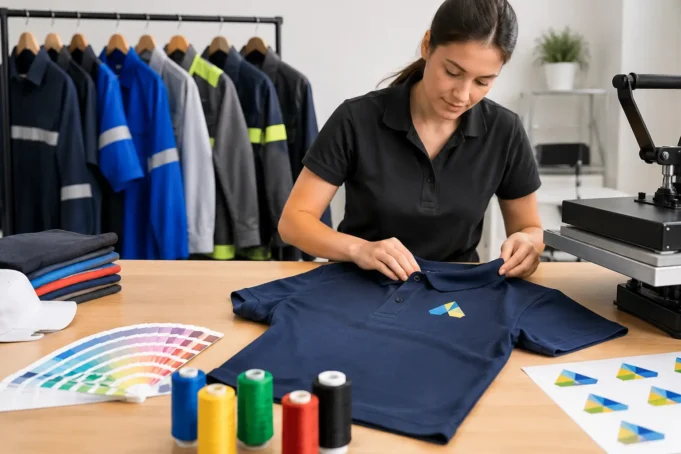
A uniform can meet every fit, fabric, and color requirement yet still weaken a brand if its logo cracks, fades, puckers, or sits in the wrong place. Garment decoration is where a plain staff garment becomes a recognizable business asset. For procurement teams, the decision is not simply embroidery versus printing. It affects perceived quality, wear life, production lead time, garment compatibility, and the consistency of every customer-facing employee.
Why garment decoration is a sourcing decision
A decoration method must work with the garment’s purpose. A premium embroidered logo may suit a hotel front-desk polo, while the same treatment can feel heavy and uncomfortable on a lightweight sports jersey. A full-color print can make a campaign shirt stand out, but it may not be the best fit for daily industrial workwear exposed to repeated washing and abrasion.
The right choice starts with the operating environment. Consider how often the uniform will be worn and laundered, whether staff work outdoors or near heat, whether the garment contains stretch fabric or waterproof coatings, and how closely customers will see the finished result. A restaurant group, school, logistics operator, clinic, and construction contractor can all use branded apparel, but their decoration requirements are fundamentally different.
Decoration also has a commercial role. A clean, consistently applied logo gives dispersed teams a common visual standard. It helps customers identify staff quickly and can make a custom made uniform program feel deliberate rather than improvised. For suppliers, clear advice on decoration options is an opportunity to position production capability beyond a price quotation.
Embroidery for durable, premium identity
Embroidery remains a popular choice for corporate uniforms because it creates texture, dimension, and a long-lasting finish. It is especially effective on polo shirts, woven shirts, jackets, caps, aprons, fleece, and heavier workwear. A small chest logo in thread often communicates permanence in a way that lightweight prints do not.
The trade-off is garment weight and design complexity. Dense stitching can pull on thin fabrics, create puckering, or make the inside of a garment less comfortable. Fine gradients, tiny lettering, and photographic artwork also do not translate well into thread. Before approving production, buyers should ask for a digitized proof and a physical sample on the actual garment fabric, not only a logo image on a screen.
Thread selection matters. Polyester thread is commonly favored for color retention and wash resistance, while specialty threads can add a metallic or reflective effect for selected applications. For workwear, visibility and durability may take priority over decorative detail. For hospitality and corporate wear, a refined stitch count, accurate logo placement, and clean backing can make the stronger impression.
When embroidery is the better fit
Embroidery is generally well suited to small logos, name personalization, executive apparel, uniforms with a premium service role, and garments expected to stay in circulation for years. It becomes less efficient when a design is large, highly detailed, or required across a very high volume of low-cost promotional shirts. In those cases, printing often produces a more practical result.
Printed garment decoration and color flexibility
Printing offers more freedom for large artwork, detailed graphics, and multi-color branding. It is often the practical route for event shirts, sportswear, promotional apparel, campaign uniforms, and designs where a logo includes gradients or fine visual elements.
Screen printing remains a strong option for repeat orders with straightforward artwork. Once screens are prepared, it can deliver consistent color and good cost efficiency at volume. It is particularly effective for bold spot-color designs on cotton or cotton-blend garments. However, each additional color can increase setup and production complexity, making short runs or frequently changing artwork less economical.
Digital transfer methods, including direct-to-film printing, have changed the conversation for small runs and detailed logos. Transfers can reproduce fine lines and full-color graphics without the same screen setup requirements. They are useful for mixed-size orders, on-demand personalization, and designs that need to be applied to different garment types. Quality varies by film, adhesive, press settings, and washing practice, so buyers should test a sample rather than assume all transfers perform alike.
Direct-to-garment printing is another option for detailed artwork on suitable cotton-rich fabrics. It can create a softer hand feel than some transfers, especially when the design does not require a heavy white underbase. Its limitations include garment compatibility, pretreatment requirements, and production speed for larger corporate orders.
Sublimation occupies a different category. Because the dye becomes part of the fabric, the finished graphic has no raised surface to crack or peel. It is an excellent choice for polyester sports jerseys, activewear, and all-over team designs. It does not work the same way on dark cotton uniforms, so it should be selected for the fabric rather than treated as a universal printing solution.
Match the method to fabric performance
Fabric is not a neutral base. It determines how decoration looks, feels, and lasts. Cotton absorbs ink differently from polyester. Stretch garments need decoration that can move with the fabric. Water-repellent outerwear may require specialized preparation or alternative branding methods because coatings can reduce adhesion.
For performance uniforms, the comfort impact deserves attention. Heavy chest embroidery on a lightweight moisture-wicking polo can affect drape and breathability. A large transfer on the back of a high-heat work shirt may feel less comfortable during long shifts. These are not minor finishing details when the uniform is worn for eight or more hours.
Color also changes the production plan. White artwork on dark garments often needs an underbase for print opacity. That can affect softness and cost. Embroidery thread colors should be matched to approved brand references, but the final appearance can vary slightly against different fabric colors and textures. A supplier sample prevents a small mismatch from becoming a full-order problem.
Patches, badges, and specialized finishes
Patches offer a useful middle ground between embroidery and direct decoration. Woven patches can reproduce finer details than traditional embroidery, while embroidered patches provide a dimensional look that can be sewn or heat-applied. They are practical for outerwear, uniforms that need a distinct badge, and programs where the garment and branding component may be managed separately.
For roles requiring high visibility, reflective transfers, reflective embroidery, or reflective patches can support safety requirements while carrying a company identifier. The decoration must be positioned so it does not interfere with mandated reflective tape or reduce its visibility. Industrial buyers should confirm relevant performance requirements rather than selecting reflective branding solely for appearance.
Names, job titles, and department identifiers add another layer of complexity. Individual personalization is valuable in healthcare, hospitality, security, and service operations, but it requires disciplined data handling. Confirm spelling, capitalization, placement, and garment allocation before production begins. Correcting personalized uniforms after application is rarely simple or inexpensive.
Build a clearer approval process
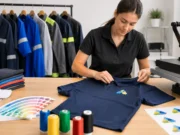
Many decoration problems are created before a production machine starts. A usable artwork file, defined color references, precise placement measurements, and a signed sample approval reduce ambiguity for both buyer and supplier. “Left chest” is not always enough direction. Specify the distance from the center front, placket, collar, or shoulder seam where appropriate, especially across multiple garment sizes.
A practical approval process should cover the logo size, decoration method, thread or ink colors, placement, garment color, and sample wash expectations. For larger orders, approve a pre-production sample. This is particularly valuable when branding is being placed on a new fabric, a stretch item, a coated jacket, or a garment sourced from a different manufacturer profile than previous orders.
Procurement teams should also separate one-time setup charges from unit pricing. Digitizing, screen preparation, artwork cleanup, and sample development may be reasonable costs, but they should be visible in the quotation. Ask whether files can be retained for repeat orders and whether future production from the same artwork will use the same specifications.
Choosing suppliers beyond the decoration price
A low unit price does not always represent the lowest program cost. Buyers should assess whether a decorator can maintain color consistency across repeat orders, manage mixed garment sizes, provide accurate mockups, and meet replenishment timelines. These capabilities matter when staff turnover, branch expansion, or seasonal hiring requires additional uniforms months after the first order.
Supplier conversations should include expected order quantities, garment fabric composition, intended wash conditions, artwork requirements, and delivery deadlines. For multi-location organizations, ask how orders are packed and labeled. A well-decorated uniform sent to the wrong branch or assigned to the wrong employee still creates an operational problem.
The most effective garment decoration program is usually the one that looks intentional after months of real work, not merely impressive in a first product photograph. Start with the uniform’s job, test the decoration on the actual fabric, and approve details that a production team can repeat. That discipline turns each logo, name, and badge into a reliable part of the staff experience and the brand customers see.