



















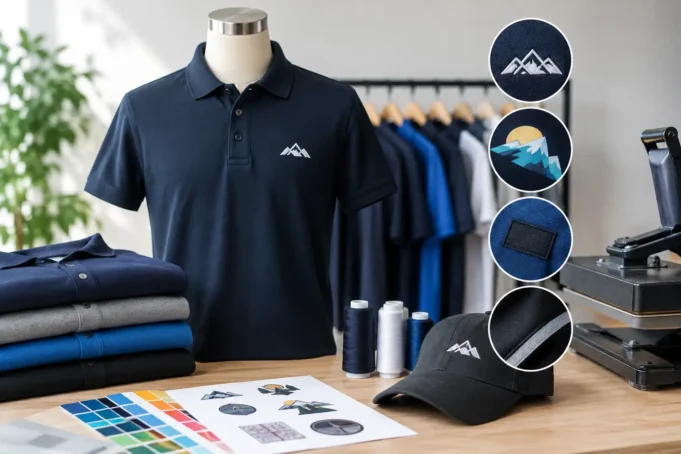
A polo shirt that looks sharp at handover can become a branding liability after ten industrial washes, a week of kitchen heat, or repeated wear under a safety vest. That is why choosing among the top uniform decoration methods is not simply a design decision. It is a procurement decision that affects garment lifespan, logo consistency, reorder costs, staff comfort, and how confidently a business presents itself.
The right method depends on the uniform’s fabric, intended work environment, logo detail, order quantity, and expected replacement cycle. A high-stitch embroidered logo may suit hotel front office shirts perfectly but feel too heavy on a lightweight performance tee. A full-color print may make sense for an event crew, while a reflective transfer is more appropriate for field staff working around traffic or machinery.
Top Uniform Decoration Methods Compared
The most reliable starting point is to match the decoration process to the garment’s job. There is no single best method for every corporate uniform, workwear program, school apparel order, or promotional campaign.
Embroidery for premium, long-term branding
Embroidery builds a logo with thread stitched directly into the garment. It remains one of the most requested options for corporate shirts, hospitality uniforms, schoolwear, caps, jackets, and premium service apparel because it communicates permanence and workmanship.
For simple logos with solid shapes and limited colors, embroidery is exceptionally durable. It generally handles repeated laundering well and maintains a polished appearance over a long uniform issue cycle. Thread color matching also gives brand managers a controlled, consistent result across shirts, outerwear, and headwear.
Its limits are equally important. Fine text, gradients, small photographic details, and very thin lines may not reproduce cleanly. Dense stitching can pucker lightweight fabric or create a stiff area against the chest. On technical fabrics, suppliers may recommend backing, stabilizers, or an alternative method to protect the garment’s stretch and drape.
Embroidery usually becomes more cost-effective when the logo stays unchanged across repeat orders. Buyers should ask whether the digitizing fee is separate, whether the file will be retained for future production, and how stitch count affects unit pricing.
Screen printing for volume and bold graphics
Screen printing applies ink through prepared screens, one for each color. It is a practical choice for large uniform runs, staff T-shirts, promotional apparel, warehouse teams, event crews, and designs with bold, uncomplicated artwork.
At higher quantities, screen printing can offer strong cost control and vibrant color coverage. A large back print that would be expensive to embroider is often much more economical as a screen print. Specialized ink systems can also support soft-hand prints, high-opacity colors on dark garments, metallic finishes, and certain performance requirements.
The trade-off is setup. Each color typically requires a separate screen, so small runs with multi-color artwork may be less attractive financially. Artwork changes also add preparation costs. Buyers should confirm whether the printer is using a water-based, plastisol, discharge, or specialty ink system, because wash feel, fabric compatibility, color effect, and curing requirements differ.
For uniforms that are washed frequently, a properly cured screen print can perform very well. Poor curing, however, can lead to cracking, fading, or peeling. Supplier quality control matters as much as the printing method itself.
Direct-to-film transfers for flexible logo placement
Direct-to-film, often called DTF, prints artwork onto film before transferring it to the garment with heat and adhesive powder. It has become popular for detailed, full-color logos, short runs, variable names, and mixed garment orders where buyers need flexibility without setting up screens for every design.
DTF can reproduce fine detail, gradients, and multiple colors more easily than traditional embroidery or multi-screen printing. It works across many cotton, polyester, and blended garments, making it useful when one organization needs the same logo placed on polos, jackets, tote bags, and work shirts.
The finished transfer can feel more noticeable than an ink print, particularly when the logo is large or heavily covered. Heat, pressure, and fabric composition must be controlled carefully to avoid scorching, dye migration, or weak adhesion. Ask for a production sample on the actual garment fabric, not only on a sample swatch.
For small and medium orders, DTF is often commercially practical. It is especially useful for departments that reorder irregularly or need individual personalization without committing to a large minimum quantity.
Heat transfer vinyl for names, numbers, and simple markings
Heat transfer vinyl, or HTV, is cut from colored film and pressed onto a garment. It is commonly used for employee names, job titles, sports numbers, safety identifiers, and simple one- or two-color logos.
Its main advantage is precision in personalization. A uniform coordinator can order a standard decorated shirt and add individual names or numbers efficiently. Vinyl also produces clean lettering and can be available in reflective, fluorescent, glitter, or specialty finishes.
For large logos or high-volume orders, HTV is usually not the most efficient option. It may feel heavier than other methods, and edges can eventually lift if the material, adhesive, and pressing conditions are not matched to the garment. On stretch garments, buyers should specify stretch-compatible vinyl rather than assuming all films will move with the fabric.
Dye sublimation for all-over performance apparel
Dye sublimation uses heat to bond dye into polyester fibers. Unlike a surface print, the color becomes part of the fabric, leaving no raised layer that can crack or peel. It is widely used for sports jerseys, activewear, delivery uniforms, cycling apparel, and performance-driven team clothing.
This method excels at full-coverage designs, gradients, repeated patterns, and vivid colors. It also keeps lightweight polyester garments breathable, which is valuable for active teams and warm working environments.
The limitation is fabric. Sublimation works best on light-colored polyester or high-polyester garments. It is not the right choice for cotton uniforms, dark cotton shirts, or applications requiring a conventional embroidered appearance. Procurement teams should also confirm that the garment construction, including seams and panels, is designed for the intended print area. True all-over sublimation is often produced before the garment is sewn, rather than added to a finished shirt.
Patches and badges for a structured uniform look
Woven, embroidered, printed, PVC, and leather-look patches give organizations a different visual language. They are frequently used on security uniforms, industrial workwear, scouting apparel, mechanics’ shirts, outerwear, and heritage-inspired hospitality concepts.
A patch can create definition where direct embroidery would be too dense or complicated. Woven patches, for example, can handle finer detail than standard embroidery, while printed patches support more complex artwork. They may be sewn on, heat-applied, or attached with hook-and-loop backing for roles that need interchangeable identifiers.
The decision should account for edge finish, attachment method, laundering conditions, and wearer comfort. A thick patch may look appropriate on a jacket but feel distracting on a lightweight polo. For safety or compliance uniforms, ensure badges do not interfere with protective features, pocket access, or visibility elements.
Choose by wear conditions, not logo preference alone
A logo file does not determine the correct decoration method by itself. Start with the uniform’s work setting. Food service teams may need finishes that tolerate frequent commercial laundering. Outdoor maintenance crews may need breathable fabrics, high-visibility elements, and decoration that does not compromise reflective tape. Healthcare teams may prioritize comfort, low-profile branding, and consistent color reproduction across scrubs and warm-up layers.
Fabric content is the next checkpoint. Cotton accepts many print methods well, while polyester can create dye-migration risks when exposed to heat. Stretch blends require decoration that flexes without distortion. Water-resistant jackets, fleece, softshell fabric, and flame-resistant garments each bring their own production considerations. Decoration suppliers should receive the exact garment style and fabric composition before recommending a process.
Logo scale matters too. A compact left-chest logo often works well as embroidery, a transfer, or small screen print. Large back graphics generally favor printing. Fine typography may need a woven patch or digital transfer, while a simple one-color emblem offers more options.
Build a clearer supplier brief
The fastest way to receive comparable quotations is to give uniform suppliers and decorators a usable production brief. Include the garment brand or specification, quantities by size and color, decoration locations, final artwork format, required delivery date, and expected reorder volume.
Also state how the uniforms will be washed and worn. A supplier cannot assess durability properly without knowing whether garments are for office use, daily field work, hospitality service, sports activity, or industrial laundering. If color accuracy is critical, provide approved brand color references and request a pre-production sample or strike-off before full production.
Do not compare quotations on unit price alone. A lower-cost option may exclude setup, artwork cleanup, backing, individual bagging, name personalization, or replacement allowances. It may also use a decoration process that is poorly suited to the garment. A better comparison measures the total delivered result: appearance, durability, lead time, consistency, and the supplier’s ability to reproduce the program months later.
Make decoration part of the uniform program
For multi-location organizations, decoration should be documented as part of the uniform standard. Record logo dimensions, placement measurements, thread or print color references, approved garment styles, and the chosen decoration method for each item. This protects brand consistency when new staff are onboarded, branches reorder, or garment availability changes.
Uniform Catalogue encourages buyers to look beyond a single product image and assess the production capability behind it. The strongest supplier relationships combine practical garment knowledge with decoration expertise, sample approval discipline, and a realistic plan for repeat supply.
The most effective uniform branding is rarely the most elaborate. It is the decoration that remains readable, comfortable, and on-brand after the uniform has done the work it was bought to do.