




















A uniform program can look responsible on paper and still create unnecessary waste if shirts fade after a few wash cycles, trousers lose shape, or replacement orders cannot match the original fabric. Sustainable uniform fabric options should therefore be assessed as a sourcing and performance decision, not simply a fiber story. For business buyers, the best choice is the one that supports staff comfort, brand presentation, service life, and realistic end-of-life handling.
For Malaysian organizations, climate adds another layer to the brief. Hospitality teams, retail crews, security personnel, healthcare staff, and field workers may need fabrics that manage heat and humidity while standing up to frequent industrial or home laundering. A lower-impact material that performs poorly in its actual workplace is rarely the most sustainable purchase.
What Makes a Uniform Fabric Sustainable?
Sustainability has several parts. Fiber origin matters, but it is only one part of the garment’s footprint. Buyers should also consider water and chemical use, recycled content, fabric durability, dyeing methods, production traceability, wash requirements, and whether the supplier can reproduce the fabric for future top-up orders.
A durable uniform that stays presentable for two or three years can be a stronger commercial and environmental choice than a lighter garment replaced every six months. This is particularly relevant for custom made uniform programs where embroidery, heat transfers, reflective trims, and tailored fittings add value that should not be discarded prematurely.
Certification can help verify material claims, but it should not replace practical supplier questions. Global Recycled Standard certification can support recycled-content claims, while Global Organic Textile Standard certification addresses organic fiber and processing requirements. Ask what certification applies to the actual fabric or garment you are buying, rather than accepting a broad claim that a factory uses certified materials somewhere in its supply chain.
Sustainable Uniform Fabric Options to Compare
Recycled polyester for performance uniforms
Recycled polyester, often made from post-consumer PET bottles or recovered textile waste, is one of the most practical options for active and high-volume uniform programs. It offers color retention, wrinkle resistance, quick drying, and good compatibility with sublimation printing. These qualities make it useful for sportswear, delivery uniforms, event apparel, housekeeping, retail polos, and branded promotional garments.
Its trade-off is breathability. A tightly knit recycled polyester polo may feel warm in humid conditions unless the construction includes moisture-wicking yarns, mesh panels, or a more open knit. Buyers should request a fabric swatch and test it with the intended decoration method. Dark sublimated areas, for example, can feel warmer than a lightly printed garment.
Recycled polyester also sheds microfibers during laundering. That does not eliminate its value, but it means procurement teams should prioritize durable construction, avoid unnecessary replacement, and ask suppliers about yarn quality and fabric weight rather than buying solely on recycled-content percentage.
Organic cotton for comfort-led roles
Organic cotton is familiar, soft, and well suited to uniforms where natural hand feel matters. It is commonly considered for corporate shirts, casual retail apparel, school uniforms, spa and wellness wear, and front-of-house hospitality pieces. Compared with conventional cotton, organic cotton is grown under standards that restrict certain synthetic inputs, depending on the certification used.
Cotton absorbs moisture well and can be more comfortable against the skin, but it dries more slowly than polyester. It can also shrink, crease, and fade if the fabric finish, dyeing process, and care instructions are not managed properly. For uniforms that receive heavy use, a pre-shrunk fabric with confirmed wash testing is more valuable than an unverified organic claim.
Organic cotton can carry a price premium and may not be necessary for every garment. A premium customer-facing shirt may justify it, while a highly abrasive warehouse or maintenance role may need a tougher blend. Match the fiber to the job rather than applying one fabric standard across every department.
Recycled cotton for lower-impact casual apparel
Recycled cotton uses cutting waste, factory offcuts, or post-consumer textiles to reduce reliance on virgin cotton. It can work well in T-shirts, fleece, casual polos, tote bags, and lower-intensity branded apparel. Its sustainability appeal is clear: it makes use of material that might otherwise be discarded.
However, recycled cotton fibers are usually shorter than virgin fibers. To maintain strength, mills often blend recycled cotton with virgin cotton, recycled polyester, or another supporting fiber. Ask for the precise blend ratio and abrasion performance. A fabric described as recycled cotton may contain a modest recycled percentage, which is not necessarily misleading, but buyers need the full specification to compare quotations fairly.
Lyocell and modal for refined comfort
Cellulosic fabrics such as lyocell and modal are made from wood pulp and can offer a smooth, breathable, premium feel. They are particularly attractive for hotel reception, premium retail, airline-adjacent service roles, officewear, and garments designed for prolonged indoor wear. In blends, they can improve drape and next-to-skin comfort.
Not all cellulosic fabrics have the same environmental profile. Responsible forestry, traceable pulp sources, and closed-loop processing are meaningful considerations. These fabrics can also be less abrasion-resistant than polyester workwear fabrics when used alone. They are often best specified in a blend for garments that need shape retention and longer service life.
Hemp and linen for limited-use applications
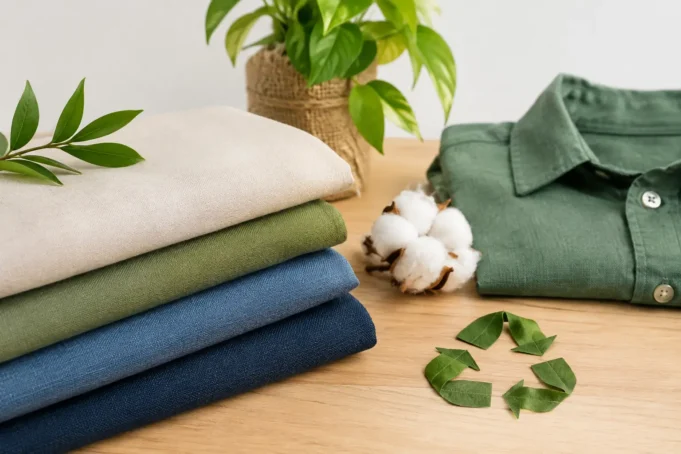
Hemp and linen create a natural, textured appearance that may suit resort uniforms, eco-focused retail concepts, food service aprons, and casual office collections. Hemp can be durable, while linen is valued for its cool feel in warm weather. Both can support a distinct brand narrative when the visual direction is relaxed and natural.
The practical limitations are creasing, potential fabric variability, cost, and limited suitability for highly standardized uniforms. They may also be harder to color-match across repeat orders. For a large multi-site program, test production consistency before committing to a fabric that will be difficult to replenish.
Fabric Blends Often Deliver the Best Result
The most responsible uniform fabric is frequently a blend, because it balances competing operational requirements. A recycled polyester-cotton blend can offer better durability and drying time than cotton alone. A cotton-lyocell blend may improve comfort for front-facing teams. Stretch fibers can improve movement for healthcare, hospitality, and service staff, though they can complicate textile recycling at end of life.
This is where buyers should avoid absolute claims. A 100% natural-fiber garment is not automatically the lower-impact choice if it has a short lifespan, needs intensive ironing, or fails in a demanding role. Likewise, a 100% recycled synthetic garment is not automatically ideal if staff find it uncomfortable and do not wear it well. Uniform supplier features and fabric data should be evaluated against the role, laundry cycle, climate, and expected replacement schedule.
Questions to Put in Every Fabric Brief
Before requesting samples or quotations, create a fabric brief that covers the operational facts suppliers need to recommend suitable options. Include the intended role, indoor or outdoor use, expected number of weekly washes, desired fit, decoration method, target budget, and whether repeat orders must match an existing uniform range.
For a meaningful sustainability comparison, ask suppliers these questions:
- What is the exact fiber composition, including recycled or organic content by percentage?
- Which material certifications apply to this specific fabric or finished garment?
- What fabric weight, colorfastness, shrinkage, pilling, and abrasion test results are available?
- Can the same fabric and color be supplied for future top-up orders?
- What decoration method is recommended, and will it affect breathability, recyclability, or garment life?
- What care instructions are needed to maintain appearance and performance?
These details also protect procurement teams from comparing unlike products. A low-cost recycled polo made from lightweight fabric is not equivalent to a heavier, colorfast, tested garment designed for repeated commercial washing.
Design and Decoration Affect the Final Footprint
Fabric selection is only part of the specification. Overly large plastisol prints, multiple badges, mixed trims, and difficult-to-remove labels can make a garment harder to recycle and more uncomfortable to wear. That does not mean branding must be minimal. It means the branding method should serve the uniform’s use case.
Embroidery is durable and well suited to corporate shirts, jackets, caps, and polos, although dense stitching can add weight and affect drape on lightweight fabrics. Digital transfers can produce detailed branding for short runs and variable names, while sublimation works especially well on polyester-based teamwear and event uniforms. Request a decorated sample, not only an unprinted fabric swatch, before approving production.
Color is another practical issue. A signature dark shade may be essential to brand identity, but it can absorb heat outdoors and show fading or lint differently across fiber types. A supplier should be able to advise on dye consistency, wash performance, and suitable alternatives where a color target creates avoidable wear issues.
Build a Program That Lasts Beyond the First Order
Sustainable sourcing works best when it is integrated into uniform management. Accurate size allocation reduces unworn stock. A planned top-up process avoids last-minute substitutions. Repair options for outerwear and work trousers can extend use, while take-back or textile-recovery partners may provide a better route for retired stock than general disposal.
For buyers using a directory or reviewing manufacturer profiles, look for suppliers that can explain their material specifications clearly, provide samples, support repeat production, and communicate realistic lead times. Sustainability claims should come with garment-level evidence and operational advice, not just a recycled icon on a catalog page.
The strongest next step is simple: select two or three fabrics for wear trials with the people who will actually use them. Their feedback on heat, movement, laundering, appearance, and fit will turn a promising sustainable fabric claim into a uniform decision that holds up in daily work.