
















A school polo program, hotel uniform refresh, or corporate workwear order can look profitable on paper until embroidery becomes the production bottleneck. That is why embroidery machine reviews should be read differently by commercial uniform buyers than by hobby users. The right machine is not simply the one with the highest needle count or brightest touchscreen. It is the one that produces consistent logos across garment sizes, holds up during repeat orders, and fits the operator, workflow, and service capacity behind the business.
For uniform suppliers, in-house decorators, and organizations assessing a production partner, the useful question is not “Which embroidery machine is best?” It is “Which setup can deliver our expected volume, design detail, turnaround time, and quality standard at a workable cost?”
How to Read Embroidery Machine Reviews for Commercial Work
Many online reviews focus on ease of use, decorative fonts, or a machine’s performance on a single cap or tote bag. Those details can be relevant for a startup, but they do not tell a procurement team much about a 300-piece staff uniform order with left-chest logos, name personalization, and multiple garment fabrics.
Give more weight to reviews that describe repeat production. Look for the garment type, thread brand, backing used, stitch count, hoop size, production speed, and the number of pieces completed. A report that says a machine ran reliably for several hours on pique polos is more useful than a general statement that it “works great.” Reviews from decorators serving hospitality, healthcare, schools, corporate apparel, and industrial workwear are particularly valuable because they face the same pressure points as uniform suppliers.
Also separate a machine review from a supplier review. A capable machine can still become a poor business investment if the local dealer cannot provide installation, operator training, replacement parts, digitizing advice, or timely technical support. For a commercial operation, downtime has a direct effect on delivery dates and customer confidence.
Start With the Production Model, Not the Machine Brand
Before comparing manufacturers, establish what the embroidery department must actually produce. A business decorating 20 to 40 garments a week needs a very different configuration from a uniform manufacturer running hundreds of polos, jackets, caps, aprons, and coveralls per day.
A single-head commercial machine can be a sensible entry point for low-volume custom made uniform work, samples, personalization, and varied small orders. It offers flexibility and a lower initial investment. The trade-off is output. One operator can only complete one garment at a time, and a large order can quickly consume the available production window.
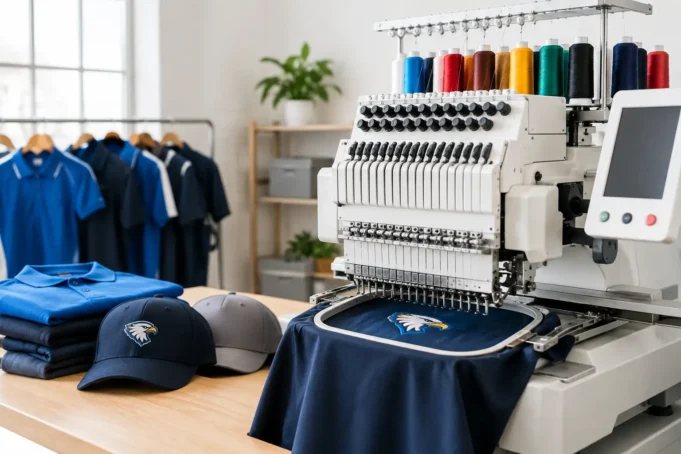
Multi-head machines are designed for repeatability at scale. Several identical garments can run simultaneously, making them more suitable for contract decoration and recurring uniform programs. However, they require more floor space, a stronger process for loading garments and trimming threads, and enough order volume to justify the investment. If one design change or thread break affects every head, operator skill becomes even more important.
Needle count matters, but it is not a shortcut to quality. A 15-needle machine reduces manual color changes for complex logos and can improve efficiency where designs use many colors. For standard corporate logos with two to five thread colors, capacity, stitch stability, and support may matter more than moving from 12 to 15 needles.
Match the Machine to the Garments You Decorate
Uniform embroidery covers far more than flat polo shirts. Pique knits can shift and pucker. Softshell jackets may need careful backing and hooping. Caps require a cap driver and a machine built to handle curved surfaces. Thick work jackets, bags, and coveralls may call for greater clearance and a more forgiving tubular embroidery system.
When reading a review, check whether the reviewer used the machine on materials similar to your product mix. A machine that performs neatly on cotton twill may need different settings, hoops, or stabilizers for stretch performance polos. Good reviews explain these conditions instead of treating all fabrics as interchangeable.
What Machine Specifications Actually Affect Uniform Quality
Stitch quality begins with digitizing, thread tension, stabilizer selection, and hooping technique. Still, the machine influences how consistently those variables can be controlled. Commercial buyers should evaluate several practical specifications.
First, examine the maximum embroidery field and the usable hoop range. A left-chest logo rarely needs a large field, but jacket backs, names, badges, and special placements may. A machine with suitable standard hoops can reduce awkward workarounds and improve garment handling.
Second, consider speed realistically. A published maximum speed is not the same as productive speed. Fine lettering, dense fills, metallic thread, cap embroidery, and difficult fabrics often require slower operation. Reviews that report stable output at a moderate speed are more credible than those that only repeat the top stitches-per-minute figure.
Third, assess thread-break detection and recovery features. These functions can reduce waste, especially on longer runs, but they are not a replacement for an attentive operator. A machine that stops accurately and returns cleanly to the missed stitch can save a batch of branded garments from becoming seconds.
Finally, look at the control interface and file workflow. The best setup accepts the design formats used by your digitizer, makes color-sequence edits manageable, and stores common logo files reliably. For companies handling multiple client accounts, organized design naming and production records are operational safeguards, not minor conveniences.
Calculate Cost Per Finished Logo, Not Purchase Price
The lowest-priced machine is not automatically the lowest-cost option. Commercial embroidery costs include labor, thread, backing, needles, maintenance, digitizing, rejected garments, electricity, financing, and lost production during downtime. The machine purchase is only one part of the decision.
A practical comparison starts with a typical job. For example, estimate the stitch count of a standard left-chest logo, the average time to hoop and unhoop each polo, the number of thread trims, and the expected hourly operator cost. Then calculate how many finished pieces can be produced during a normal shift at a realistic running speed.
This approach exposes common problems. A lower-cost unit may appear attractive but require more operator intervention, creating higher labor cost per garment. Conversely, a multi-head machine can be inefficient if the business mainly handles short, mixed-logo orders that take too long to set up. The right answer depends on order profile, not prestige.
For buyers outsourcing embroidery, this same calculation helps evaluate supplier quotations. Ask how the supplier handles minimum quantities, logo setup, individual names, rush orders, and replacement garments. Low unit pricing can lose its value if the supplier cannot maintain color consistency across future orders.
Service Support Is Part of the Equipment
Embroidery equipment is a production asset, so service coverage deserves the same scrutiny as the machine itself. Ask dealers or machine suppliers where technicians are based, typical response times, whether remote diagnostics are available, and which spare parts are stocked locally. A replacement hook, needle bar component, or control-board issue can stop production completely.
Training should cover more than turning the machine on. Operators need practical instruction in tension checks, thread-path troubleshooting, backing selection, hooping difficult garments, basic preventive maintenance, and quality inspection. If a supplier offers only a brief demonstration, budget for additional training and a period of supervised production.
It is also wise to ask about the availability of compatible hoops, cap frames, software, needles, bobbins, and approved accessories. A machine ecosystem that is easy to replenish supports predictable production. An obscure model with limited local parts may be risky even when its specification sheet looks impressive.
A Better Shortlist for Uniform Businesses
Rather than collecting dozens of general ratings, build a short comparison around real uniform requirements. Request a live sample using your logo file, your preferred thread colors, and a garment close to what you sell. Inspect small text, edge definition, registration, backing show-through, and the appearance of the inside of the garment.
Ask the vendor to run the same logo on a polo, a cap if relevant, and a heavier jacket or workwear fabric. This is where differences in hooping, stability, and operator knowledge become visible. Review the finished pieces after laundering when possible, particularly for uniforms that will be washed frequently.
For organizations that are not ready to buy equipment, supplier selection can achieve the same goal. Look for embroidery specialists with documented capacity, clear sampling processes, consistent digitizing standards, and experience with the sectors you serve. Directory listings, manufacturer profiles, and buyer guides can help procurement teams identify providers, but a physical sample remains the strongest proof of fit.
The most useful decision is rarely the machine with the most features. It is the embroidery setup that keeps logos sharp, garments saleable, operators productive, and uniform programs dependable when the next repeat order arrives.