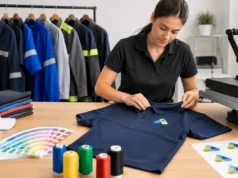























A hospitality team needs a small batch of black polos with colorful event logos. A facilities contractor needs hi-vis workwear marked with individual department names. A school wants artwork that stays sharp across cotton tees, polyester sportswear, and staff jackets. These are the practical situations where DTF printing for uniforms has become a serious option for buyers, not just a decoration trend.
Direct-to-film, or DTF, transfers a digital design from a printed film onto a garment using adhesive powder and a heat press. The result is a flexible printed layer that can reproduce fine detail, gradients, and strong colors on many fabric types. For organizations managing mixed garment ranges, frequent staff changes, or short-run campaigns, that flexibility can solve problems that traditional screen printing or embroidery may not handle as efficiently.
It is not automatically the best choice for every uniform program. Procurement teams should assess DTF against garment use, order volume, logo requirements, wash expectations, and the visual standards of the brand.
Where DTF Printing for Uniforms Makes Commercial Sense
The strongest case for DTF is versatility. Unlike screen printing, which can become costly when artwork uses several colors or when quantities are low, DTF is digitally produced. A complex full-color logo does not require separate screens for each color. This makes it well suited to branded uniforms with photographic elements, color fades, detailed mascots, multicolor sponsor logos, or small text.
For Malaysian uniform buyers sourcing for regional teams or international brand programs, this matters when artwork is fixed but garment styles vary. A supplier can apply the same transfer to cotton polo shirts, polyester performance tees, cotton-blend jackets, tote bags, and selected workwear fabrics, subject to testing. That can simplify artwork management and help maintain brand consistency across departments.
DTF also supports short runs and variable information. A restaurant group may order 20 replacement aprons with different staff names. An event organizer may need 60 shirts carrying individual roles, dates, or partner logos. A security provider may need a limited number of branded outerwear pieces between larger uniform issues. Producing these through a screen-print setup may be inefficient; DTF can be more commercially practical.
Turnaround is another consideration. Many decorators keep ready-to-press transfers or can produce them quickly after artwork approval. Fast production should never replace quality control, but it can help uniform suppliers respond to urgent onboarding, activation, and replenishment requirements.
What the Finished Print Looks and Feels Like
DTF typically produces vivid, opaque color, including on dark garments. Because the ink sits on top of the fabric, designs can look crisp and high-impact, particularly for chest logos, back graphics, promotional uniforms, and sports apparel.
The trade-off is hand feel. A large DTF design creates a noticeable printed area, sometimes called a transfer “patch” by wearers. On a lightweight shirt, a full-front print can feel warmer and less breathable than dye sublimation or a carefully designed water-based screen print. For customer-facing corporate uniforms worn indoors, this may be acceptable if the logo is modest in size. For workers spending long hours outdoors or in high-heat environments, print coverage deserves closer attention.
Good design decisions reduce this issue. Avoid turning a large solid background into part of the transfer when it is not essential. Use a clean logo shape rather than placing it inside a large rectangle. Ask the printer whether fine isolated elements will hold correctly and whether the garment color can become part of the visual design.
DTF also has a different visual character from embroidery. Embroidery delivers texture, dimension, and a traditional premium appearance that many hotels, financial institutions, clubs, and corporate offices still prefer. DTF is usually better when accurate color reproduction and detailed artwork matter more than texture. Some uniform programs use both: embroidered polos for management and front-office teams, with DTF used for campaign tees, outerwear graphics, event uniforms, or detailed secondary logos.
Fabric, Garment Construction, and Job Conditions
A uniform decoration method should be selected after the garment, not before it. DTF works across a broad range of materials, including cotton, polyester, cotton-poly blends, and many performance fabrics. However, “works on” is not the same as “is suitable for every use.”
Polyester is a common concern. Some dyed polyester garments can release dye when exposed to heat, creating discoloration around or through a print. This is known as dye migration. It is particularly relevant for deep reds, maroons, navies, royal blues, and certain sublimated sportswear. A quality printer may use specialized low-bleed materials, but the only reliable procurement approach is to request a test on the actual garment color and fabric.
Water-resistant, coated, heavily textured, ribbed, or stretch fabrics also need testing. Adhesion can vary based on surface treatments and garment construction. A transfer that performs well on a smooth polyester polo may fail early on a coated jacket or crack excessively on a high-stretch sleeve panel.
Think about the worker’s environment as well. DTF may be appropriate for retail associates, delivery teams, promotional crews, school activities, casual hospitality uniforms, and many office-support applications. For industrial roles exposed to intense heat, chemicals, abrasive surfaces, or flame hazards, decoration decisions must align with the garment’s safety specification. Applying a standard transfer to flame-resistant workwear can affect compliance or garment performance. Buyers should obtain guidance from both the workwear manufacturer and decoration provider before approving branded safety apparel.
Durability Depends on Process Control
A well-produced DTF transfer can withstand repeated washing, but durability is not guaranteed by the letters “DTF.” It depends on the film, inks, adhesive powder, curing process, press temperature, pressure, dwell time, garment compatibility, and post-press finishing.
Procurement teams should avoid evaluating samples only by appearance on delivery day. Ask for a wash-tested sample, preferably on the intended garment. Review the edges of the print, fine lettering, white underbase, stretch areas, and color stability after multiple wash cycles. A strong transfer should not lift at corners, crack prematurely, or lose large areas of color under normal care conditions.
Care instructions matter. Most printed uniforms perform better when washed inside out, in cold or warm water, without aggressive bleaching, then dried at a lower temperature where possible. These requirements need to be realistic for the workplace. If uniforms will be sent through commercial laundries, exposed to high drying temperatures, or washed frequently in demanding environments, state that upfront. The supplier may recommend a different decoration method, a different transfer specification, or a revised garment choice.
Specifications to Give a Uniform Supplier
Clear briefs reduce approval delays and prevent costly variation between batches. For DTF work, provide the approved artwork in vector format where possible, such as AI, EPS, or PDF, along with high-resolution raster files for detailed images. Specify the logo size and location rather than relying on a vague instruction such as “left chest.” A 3-inch chest mark and a 4-inch chest mark create very different visual results.
Also confirm whether the artwork includes a white underbase, whether Pantone matching is required, and what tolerance is acceptable for printed color. DTF can produce excellent color, but screen-to-print variation and garment color can affect perception. If the logo is governed by strict corporate brand standards, approve a physical sample under normal lighting before full production.
For recurring orders, record the garment brand, style code, fabric composition, color name, print dimensions, placement measurements, artwork version, and application settings used by the supplier. This creates a repeatable specification instead of forcing each reorder to begin from zero. It is especially useful for multi-location businesses where uniform consistency affects customer recognition.
Cost: Compare the Whole Job, Not Just the Unit Price
DTF can be cost-effective for low quantities and multi-color artwork, but unit pricing alone can be misleading. A low transfer price is less valuable if the print feels overly heavy, fails after a few washes, or requires remaking a batch. Compare quoted prices alongside garment quality, sample approval, print size, color complexity, setup charges, turnaround, packing, and replacement terms.
For large orders with simple one- or two-color graphics, screen printing may still offer better economies of scale and a lighter feel. For uniforms needing a refined, dimensional logo in small quantities, embroidery may justify the higher cost. For all-over polyester teamwear, sublimation can be the more natural fit. The right method depends on the job, which is why buyer guides for selecting uniform suppliers should focus on capability rather than a single decoration label.
A Practical Approval Process
Before placing a full uniform order, request one pre-production sample that matches the final garment, final artwork, intended placement, and expected print size. Inspect it at arm’s length and close range. Check that the logo sits level, that small lettering remains readable, and that the print does not interfere with seams, pockets, zippers, reflective tape, or name badges.
Then conduct a basic wear and wash check. Stretch the printed area lightly, wash it according to the intended care routine, and assess whether the garment remains comfortable. If the design covers a large area, ask a staff member to wear it during a normal shift. Procurement feedback is most useful when it includes the wearer’s experience, not only the brand manager’s visual approval.
DTF gives uniform buyers another capable tool for building a consistent, responsive apparel program. Choose a supplier that can explain the limits as clearly as the benefits, test the actual garment before production, and document the approved specification. That discipline turns a fast decoration method into a reliable part of the uniform supply chain.